


Want your ads to show up in AI Mode? Google says that this is possible through AI Max and Performance Max. Currently, they’re testing a new generation of ad formats powered by Gemini. At Google Marketing Live 2026, it was announced that AI Max and Performance Max are powering ads shown through AI Mode.
Ads in AI Mode Enhancements:
- Sponsored Ads – can show what the product is and how it relates to whatever the user searched using Gemini.
- Direct Offers – brands can offer discounts, local coupons, & custom deals.
- Shopping Ads – typical shopping ads, but it shows a description of the product based on what the user searches for.
- Business Agent for Leads (only available for education, automatic, and real estate industries) – users can ask questions inside of an ad, which can lead to a conversation with an agent, and will help fill out forms for better lead generation.
- AI Brief – can give AI Brief a creative guideline with natural language, can include guardrails, and can review/edit ad before launch to help with ad copies.
Is this the new automated future of Google Ads for hotels? Let’s discuss the reality of these “hands-off” AI Max ads, specifically for individually branded hotels like an AC Hotel somewhere in Minneapolis, or one of Hilton Garden Inn Hotels in Dallas.
The Reality of AI Max:
While it’s recommended by Google to adopt AI Max for Search campaigns, we have not seen this as a benefit for individually branded hotels. Why? Because by enabling AI Max, you’re allowing Google to take the wheel on search term matching and asset optimization.
Google says that the benefit of using search term matching is that it “expands on existing targeted keywords using broad match and keywordless technology to find more relevant and high-performing search queries — queries and conversions that you’d otherwise miss. Google AI will learn from your current keywords, creatives and URLs to help you show up on more relevant searches.” But for individually branded hotels, the risk of using broad match and keywordless technology can attract irrelevant searches such as “hotel,” or “1 800 marriott” or “marriott central reservation.”
Even when trying to dig deeper into the upgraded Keyword Report, there are no further details on these expanded keywords through AI Max because all efforts are lumped into a “Total: AI expanded matches.”
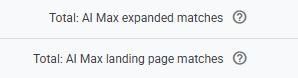
Same with final URL expansion as seen above, where performance is lumped into a “Total: AI Max landing page matches.” While final URL expansion can be a benefit for soft-branded hotels directing to a vanity site and independent hotels, Google requires text customization to be turned on to ensure that the ad copy matches the landing page. For individual branded hotels, this can be an issue since “Google automatically sends users to the landing page from your domain that is predicted to perform best and serves relevant ad copy customized to user intent.” This again poses a problem for the Hilton Garden Inn in Dallas due to the overarching brand URL structure, so enabling AI Max allows Google to serve ad copies and direct potential traffic to a competitor hotel. The same URL structure applies to other hotel brands with Marriott, Hyatt, IHG, and Choice Hotels.
While there are new “Ad group settings for AI Max,” such as being able to target “locations of interest,” this is already a setting that exists within Search Ads. And with “brand controls,” where Google allows you to “specify the exact brands you want your ads to be associated with, or prevent your ads from appearing alongside specific brands,” this again only benefits overarching brand hotel marketing for Marriott, Hilton, Hyatt, IHG, Choice, and Online Travel Agencies (OTAs).
Let’s Dive In AI Mode:
When using AI Mode and asking “what’s the best hotel in Dallas?” the first mentioned hotel is from Forbes Travel Guide’s website.
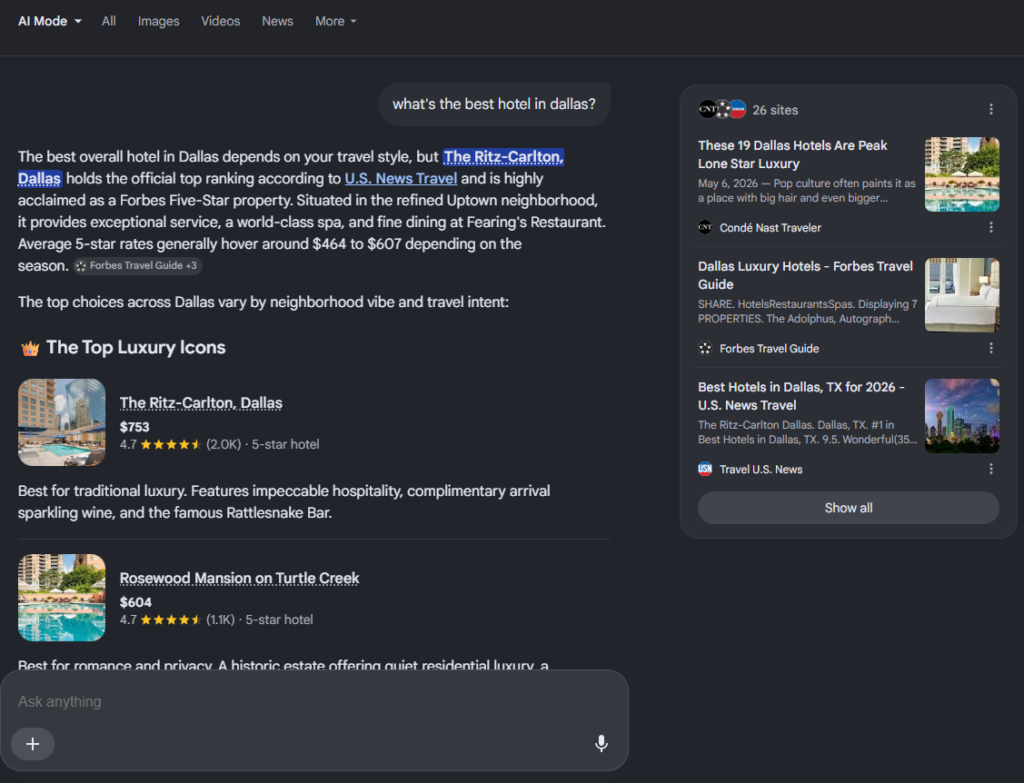
This shows the importance of organic SEO and the new hotel AI funnel. Some best practices from Google’s Marketing Live include:
- Lead with what your brand can uniquely say on your own website. Be specific, and have one-of-a-kind content.
- Share guest reviews and testimonials.
- Focus on the most helpful content because this is what gets rewarded by Google. Don’t write for bots.
- Be agent-ready (Google Business Profile and Merchant Center).
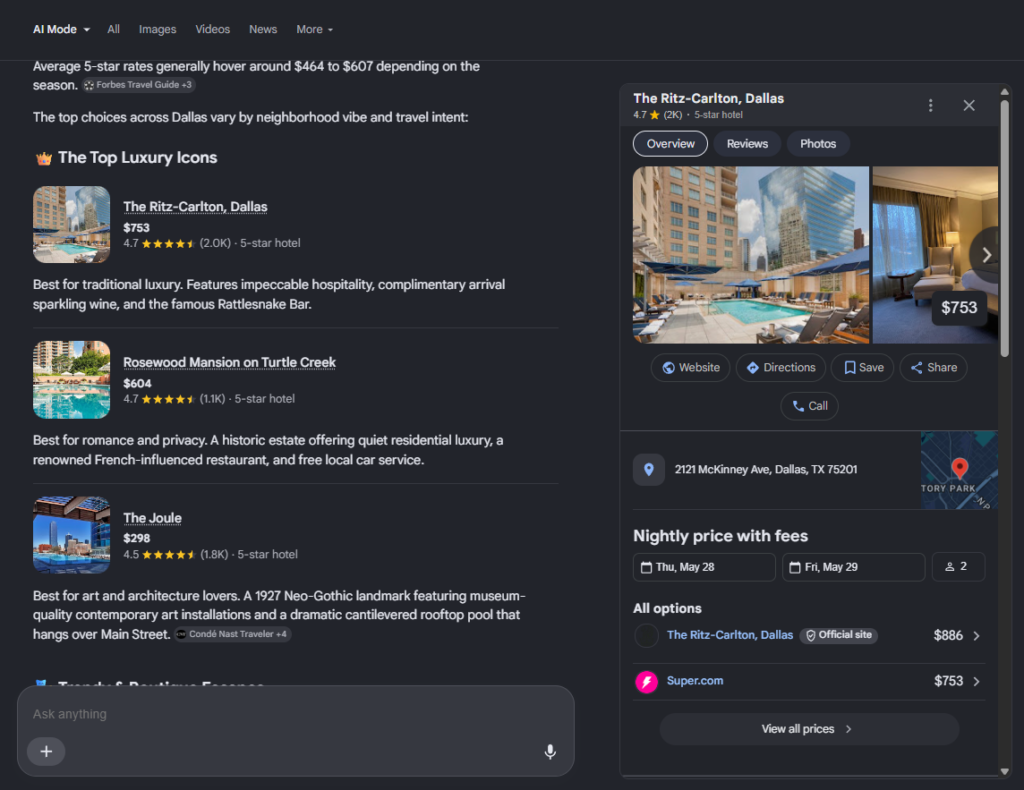
When you click on the recommended hotel in this AI Mode, it opens up a box showing the hotel’s Google Business Profile (GBP) and rates through Metasearch:
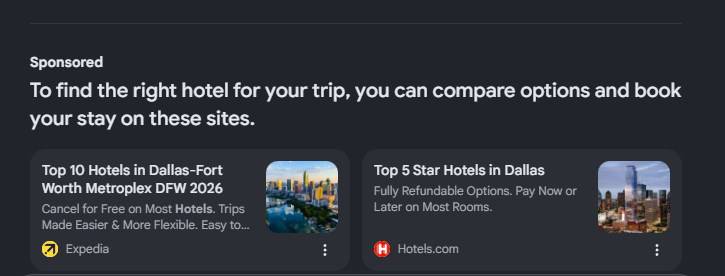
Ads in AI Mode are appearing at the bottom of the query:
AI Max campaigns can be great for advertisers who want a hands-off approach, but we see this especially as a benefit for overcharging brand marketing and OTAs, as AI Max allows them to promote multiple hotels across multiple destinations.
The 411 of AI Max Campaigns:
Total features available in AI Max campaigns include:
- Search term matching – Uses broad match, asset-based, and landing page-based technology to improve campaign reach.
- Text customization (formerly known as “automatically created assets”) – Uses text from existing ads, landing page copy, and assets along with generative AI to create customized ad copy to be more relevant to specific user searches.
- Final URL expansion – Sends traffic to the most relevant URLs on the website that will result in better performance.
- Locations of interests – Reaches specific customers based on their geographical intent, even in keywordless matches.
- Brand settings – Specifies the exact brands you want your ads to be associated with (brand inclusions), or prevent your ads from appearing alongside specific brands (brand exclusions).
- URL inclusions – Utilizes URL inclusions to include URLs that were not captured by the final URL expansion.
- URL exclusions – Excludes specific URLs from serving as landing pages in your campaign.
Google, Take the Wheel!
Ready to adopt AI Max for an existing Search campaign? Follow these steps:
- In your Google Ads account, go to Settings within the Campaigns menu.
- Select the Search campaign you’d like to update.
- Select AI Max in the section menu.
- Toggle to opt-in to AI Max settings.
- Select the specific AI Max features you want to use in your campaign, such as Search term matching or Asset optimization.
- Select Save.
Ensure that you’re reviewing your campaign’s performance through Google Ads’ Search Terms report, Keywords report, landing pages report, and asset report. Also, review the campaign’s performance in Google Analytics (in the Traffic Acquisition Report and Advertising Report) to see how much of your campaign is driving actual conversions.
Not sure if AI Max is right for your property?
Every hotel’s paid media strategy is different, and the “set it and forget it” approach isn’t always the win Google makes it out to be. If you want a second opinion on your own Search campaigns, help auditing your keyword and URL settings, or just want to talk through what AI Max means for your specific brand and market, let’s chat.